Info Graphic
I've been digging pretty heavily into Michigan's offensive play-calling this season, trying to put some actual numbers behind what we've all been watching.
One thing that's frustrated me with Jason Beck's offense is how often we seem to run east-west instead of attacking downhill. So I wanted to see if the numbers actually backed that up.
I analyzed play-by-play data from 122 FBS teams through October 24, looking at how frequently teams run left or right compared to up the middle, and how productive those runs are.
Here's what I found:
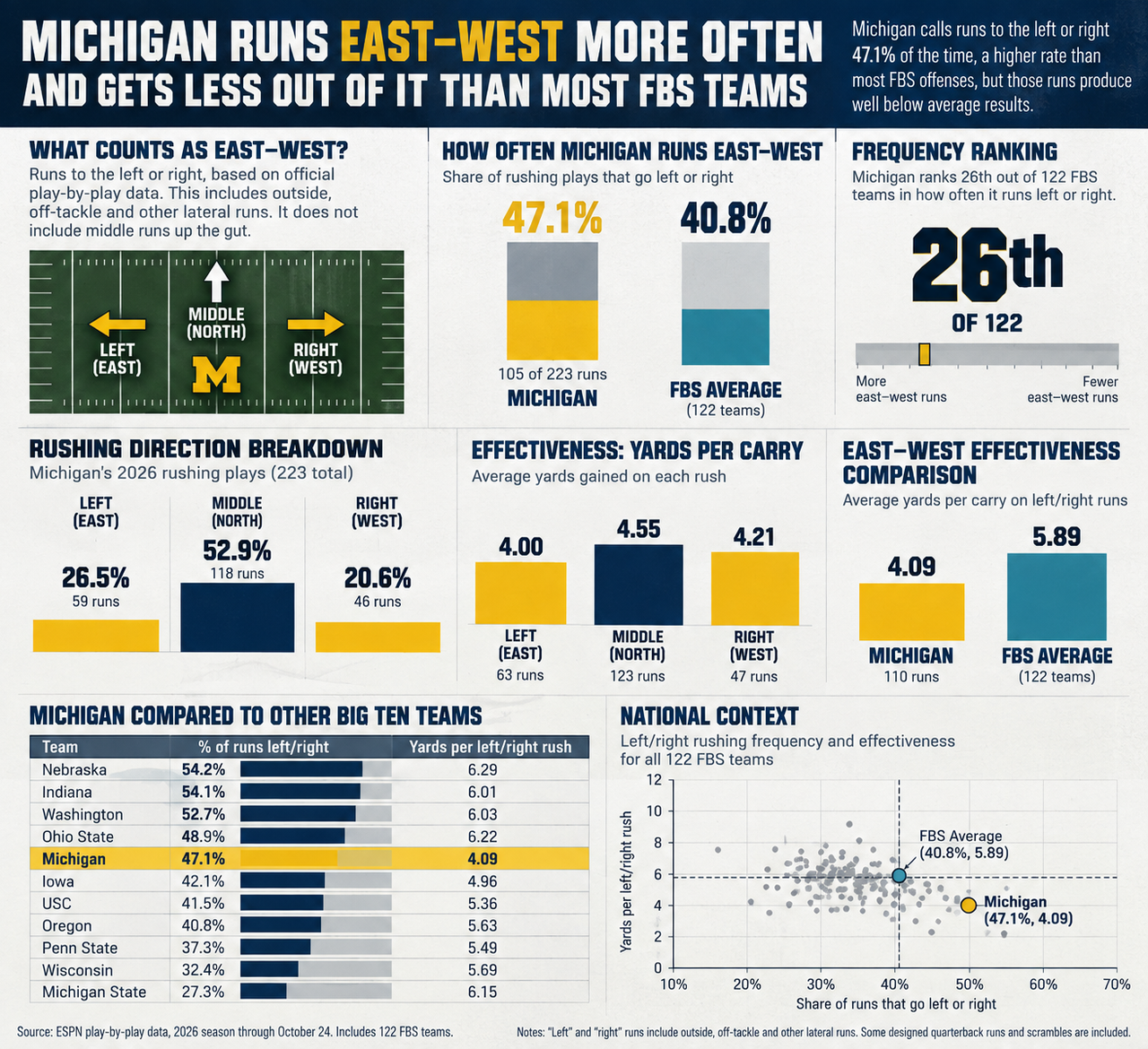
How often Michigan runs east-west:
- Michigan: 47.1% of directional runs
- FBS average: 40.8%
- Michigan ranks 26th out of 122 teams in frequency.
How effective those runs are:
- Michigan: 4.09 yards per carry
- FBS average: 5.89 yards per carry
- Michigan ranks 117th out of 122 teams in production.
So Michigan runs east-west more frequently than roughly 79% of the teams in our dataset, despite being less productive on those runs than roughly 95% of them.
And here's another interesting part: Michigan averages 4.55 yards running up the middle, compared to 4.09 running left or right.
Now, there's an important distinction here. The play-by-play data identifies runs as left, middle, or right. Not every left or right run necessarily goes outside the tackles, so east-west is being used as a general description rather than a perfect classification.
And I'm not suggesting that every unsuccessful run is Beck's fault. Blocking, personnel, defensive alignment, and execution all matter.
But I do think it's fair to question why we're calling these runs at a higher rate than most of the country when we're getting considerably less production from them.
This is what I've been trying to understand about Beck's philosophy. Is he adapting his offense to what Michigan's players are actually doing well, or is he continuing to call the offense he wants to run regardless of the results?
I'm not arguing Michigan should exclusively run between the tackles. Obviously, you need variety to keep defenses honest.
But when you're near the bottom of FBS in production on a type of run you call more often than most teams, I think that's worth examining.
At what point does sticking with your offensive philosophy become refusing to adjust to your personnel?
Data Source & Methodology
All statistics were calculated using ESPN's college football play-by-play data for the 2026 season, through October 24.
I downloaded the individual game records and used Python to analyze rushing plays across 122 FBS programs with usable data.
Here's how the numbers were calculated:
- Rushing direction: Runs were classified as left, middle, or right using directional information in ESPN's play descriptions.
- East-west frequency: Left and right rushes were combined and divided by the total number of runs with an identifiable direction.
- Effectiveness: Total rushing yards divided by rushing attempts for the applicable direction.
- National comparison: Each team's frequency and yards-per-carry figures were calculated separately. The FBS averages represent the equally weighted average of the teams in the dataset, rather than pooling every rushing attempt together.
- Rankings: Teams were ranked by their percentage of left/right rushing attempts and their average yards per carry on those attempts.
A few important limitations: This is a 122-team sample, not every FBS program. ESPN's directional descriptions are not the same as detailed film charting, so some off-tackle runs may be classified alongside true outside runs. Quarterback rushes and scrambles may also be included. The frequency and efficiency figures were produced using slightly different classification filters, which is why their Michigan carry totals aren't identical.
This is descriptive analysis, not an opponent-adjusted efficiency model. It doesn't account for defensive strength, blocking assignments, or play design.
The goal isn't to claim these numbers prove Beck is a bad play-caller. It's to examine whether the actual production supports how frequently Michigan chooses to attack in certain directions.
Source: ESPN College Football — game-level play-by-play data, independently compiled and analyzed with Python.